Why Traditional Japanese Tattoos Have Strict Laws of Nature
Traditional Japanese tattooing (Irezumi or Wabori) isn’t just an art style. It’s a rigid system governed by the laws of nature, seasons, and ancient mythology.
Seasons cannot mix. You can’t pair a spring flower (Cherry Blossom) with an autumn leaf (Maple) or a hibernating animal (Snake).
Direction matters. A Koi swimming up means you’re currently fighting a battle. Swimming down means you’ve already won it.
Backgrounds follow physics. Water must flow naturally, wind must swirl, and fire must rise.
At RJ Tattoo Studio in Pune and Mumbai, we respect the ancient rules of Irezumi. We’ll politely refuse to design a Japanese piece that breaks these fundamental laws, because to break them is to disrespect the centuries of history behind the art.
I want to tell you about something that happens at RJ Tattoo Studio in Pune almost every single week.
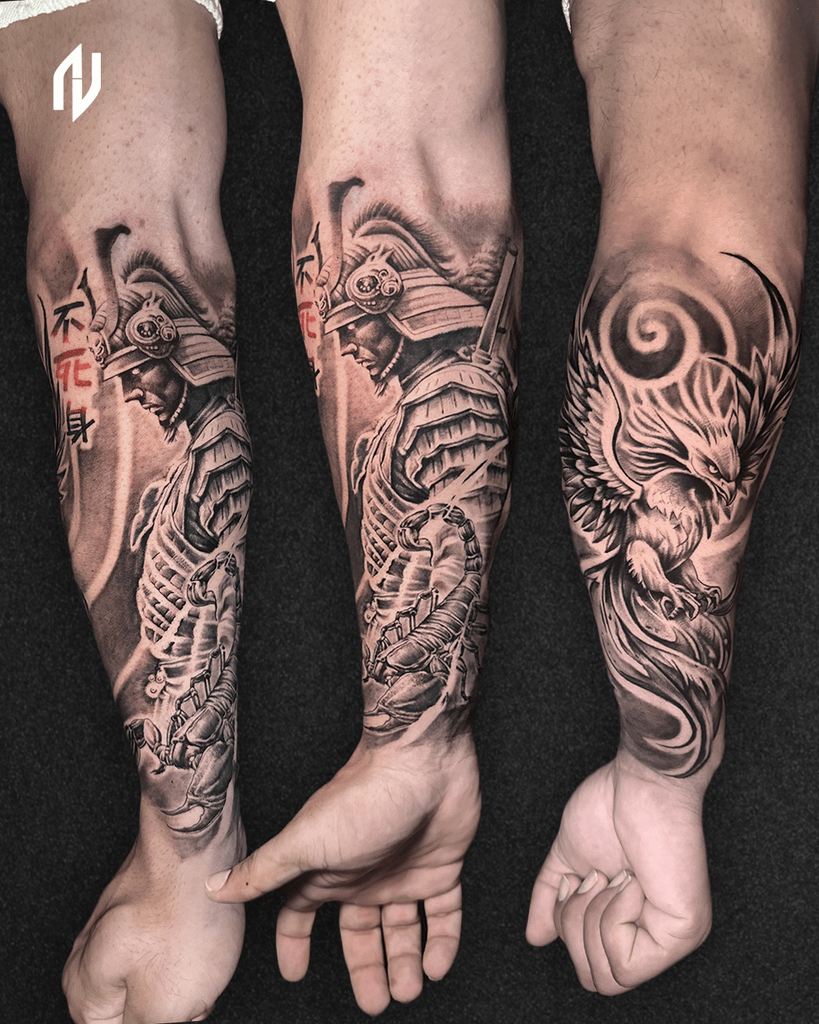
A client walks through our doors, super excited, phone in hand. They’ve got a Pinterest board ready to go, and it looks amazing. A fierce dragon wrapped around a tiger, swimming through ocean waves, surrounded by cherry blossoms and autumn maple leaves all at the same time.
And look, I get it. Visually, in a Western context, that combination can look absolutely stunning. But in the context of true traditional Japanese tattooing? Honestly, it’s a disaster. It breaks almost every fundamental rule of the art form. And I’d rather sit down with you and explain why than just smile and ink something that would make a Japanese master shake his head.
See, Western tattooing is all about individual freedom. You can stick a skull next to a rose, a clock next to a compass, and a lion wearing a crown on top of all of it. The only real rule is that it looks good on your skin.
Traditional Japanese tattooing doesn’t work that way. Not even close. It’s arguably the most disciplined, historically rigid, and deeply respected tattoo style on the planet. Every single element is governed by the laws of nature, the progression of the four seasons, and centuries of mythology. When you get an Irezumi piece, you aren’t just getting a picture on your body. You’re wearing a story that has to make logical, biological, and mythological sense.
Whether you’re coming over from Koregaon Park, Kothrud, or making the drive down the expressway from Mumbai specifically for a Japanese piece, I want you to really understand the rules that govern this art before you sit in the chair. So let me take you through every single one of them.
What Makes a Tattoo Truly Traditional Japanese (Irezumi)?
A tattoo is truly Irezumi when it follows the strict compositional rules of nature, seasons, and mythology that originated during Japan’s Edo period (1603-1867). It’s not simply a Japanese-themed image slapped onto skin. It’s a cohesive, narrative body suit designed as one single composition.
Here’s a bit of history. During the Edo period, tattoos were primarily worn by firefighters, laborers, and eventually the Yakuza as symbols of ultimate endurance, bravery, and spiritual protection. The designs were heavily adapted from Ukiyo-e woodblock prints, which depicted legendary heroes, mythical beasts, and violent clashes of nature.
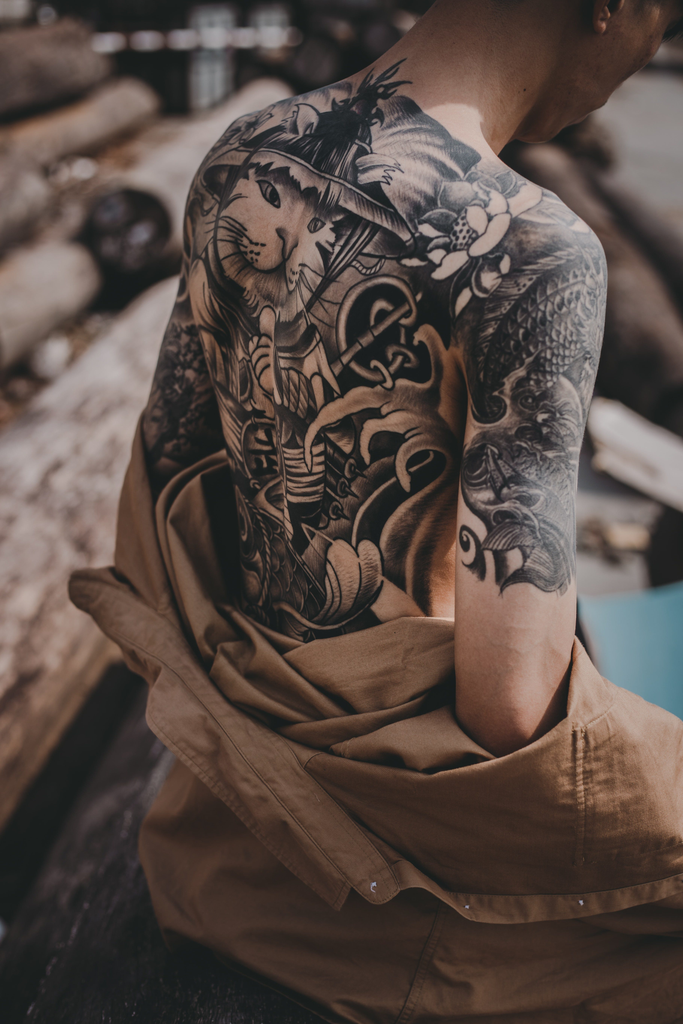
The core philosophy of Irezumi is that the tattoo is a singular, cohesive suit of armor. A true Japanese body suit (Horimono) isn’t a collection of random stickers placed on the skin over time. It’s one massive, connected composition. Even if you’re only getting a half-sleeve right now, that sleeve needs to be designed as if it could eventually connect to a full back piece down the road.
To achieve this kind of harmony, Japanese tattoo masters (Horishi) developed a strict set of rules based on their careful observation of the natural world. And the logic is beautifully simple: Nature does not contradict itself. Snow doesn’t fall in the heat of summer. A fish doesn’t swim through the clouds. So a Japanese tattoo can’t contain those contradictions either.
Why Can’t You Mix Seasons in a Japanese Tattoo?
You can’t mix seasons because every motif in Irezumi is assigned to a specific season, and pairing elements from different seasons creates a biological impossibility that any traditional master would instantly spot as a flawed tattoo. This is the single most important rule in all of Irezumi, and it’s the one clients unknowingly try to break the most.
In Japan, the four seasons (Shiki) are deeply tied to spirituality, poetry, and the impermanence of life. So if your left arm is designed as a spring sleeve, then every single element on that arm – every flower, every animal, every breeze – has to belong to spring. No exceptions.
Here’s the complete seasonal breakdown so you can see how it all works:
The Irezumi Seasonal Motif Guide
Season Japanese Flowers Paired Animals Elements Core Meaning
Spring 春 (Haru) Cherry Blossom (Sakura), Peony (Botan) None (snakes still hibernating) Gentle wind, early rain Beauty, bravery, fleeting life
Summer 夏 (Natsu) Lotus (Hasu), Iris Koi (active), Frogs Water, ponds, heat Enlightenment, purity, struggle
Autumn 秋 (Aki) Maple Leaf (Momiji), Chrysanthemum (Kiku) Snake (awake), Deer Wind, falling leaves Resilience, maturity, royalty
Winter 冬 (Fuyu) Plum Blossom (Ume), Bamboo Crane Snow, bare branches Endurance, hope, fierce resilience
Spring (Haru) – The Season of the Samurai
The Cherry Blossom (Sakura) is the ultimate symbol of the Samurai. Think about it: it blooms brilliantly, stops everyone in their tracks with its beauty, and then falls to the ground in a matter of days. Right at the peak of its beauty, it’s gone. That’s why it represents a glorious but tragically short life. The Peony (Botan) is called the “King of Flowers,” and it represents wealth, good fortune, and masculine bravery.
The Rule: Cherry blossoms bloom in early spring when the air is still bitterly cold. At that time, snakes are still hibernating deep underground. They simply don’t exist in the spring landscape. So pairing a snake with cherry blossoms doesn’t just look wrong to a Horishi. It’s biologically impossible.
Summer (Natsu) – The Season of Enlightenment
The Lotus (Hasu) is one of my personal favorites, and here’s why. It literally grows in muddy, stagnant, disgusting water, but it emerges pristine and beautiful. It’s deeply tied to Buddhism, representing enlightenment, purity, and the struggle to rise above the darkness of the world. I’ve had clients tear up when I explain what their lotus actually means.
The Rule: Lotus flowers live in water. That’s their home. So they’re almost always paired with water motifs like ponds and rivers. You won’t see a lotus paired with high mountain winds, because that’s just not where they exist in nature.
Autumn (Aki) – The Season of the Emperor
The Chrysanthemum (Kiku) is the flower of the Japanese Emperor himself. It blooms in the harsh, cooling conditions of autumn, representing longevity and royal strength. Maple Leaves (Momiji) represent the slow, beautiful decay of life, and they’re absolutely stunning when done right.
The Rule: Maple leaves should be depicted blowing in the autumn wind or floating on water. You absolutely cannot place a maple leaf next to a cherry blossom in the same composition. One blooms in March, the other falls in October. They never coexist in the natural world, and they can’t coexist on your skin.
Winter (Fuyu) – The Season of Endurance
Plum Blossoms (Ume) are something truly special. They bloom in the dead of winter, often while covered in snow. I always tell my clients that the plum blossom is the flower for people who refuse to give up. It represents fierce resilience and the ability to thrive when the world around you is cold and unforgiving.
When you sit down with us at RJ Tattoo Studio to design your sleeve, the very first question I’ll ask is: “What season speaks to you?” Once you choose your flower, you’ve locked in the season. Every other element we draw has to obey that choice. It’s non-negotiable.
Planning a Japanese sleeve in Pune and Mumbai? We offer free Irezumi consultations where we walk you through seasonal pairing, direction, and composition before a single line is drawn.
Let’s build your story the right way.
What Does the Direction of a Koi Fish Tattoo Mean?
A Koi swimming upstream means you’re currently fighting a battle in your life. A Koi swimming downstream means you’ve already conquered your struggle and you’re returning with wisdom. The meaning changes drastically based entirely on which direction the fish is facing, and getting this wrong changes the entire message of your tattoo.
The rules governing the Koi are based on an ancient Chinese legend known as the Dragon Gate (Longmen). Here’s the story: thousands of Koi fish swim up the Yellow River against the raging current. When they reach a massive waterfall, most of them give up and get swept away. But if a single Koi is strong enough to leap all the way to the top and pass through the Dragon Gate, the gods reward its perseverance by transforming it into a magnificent, golden Dragon.
It’s one of the most powerful metaphors in all of Asian mythology. And it’s why the direction of your Koi matters so much.
Swimming Upstream (Ascending Koi)
If your Koi is tattooed swimming up your arm or leg, it tells the world that you’re currently in the middle of your fight. You’re battling against the current. Maybe you’re facing massive obstacles in your career, your health, or your personal life, and you haven’t reached that waterfall yet. You’re wearing the Ascending Koi to give yourself the strength and the reminder to keep pushing.
Swimming Downstream (Descending Koi)
If your Koi is tattooed swimming down your arm or leg, the story is completely different. It means you’ve already conquered your waterfall. You fought your battles, you won, and now you’re swimming back home with the wisdom and strength you gained from the experience. It’s a mark of victory.
The Transformation Phase (Dragon-Koi)
This is the really special one. If you want to show a Koi actively turning into a dragon, there’s a strict visual rule that has to be followed. The head has to begin taking on the horns, whiskers, and fierce eyes of a dragon, while the lower body stays as the tail of a fish. This specific motif (the Longmen or Dragon-Koi) must always be surrounded by violently crashing water and rocks, because it represents the exact, explosive moment the fish crosses the waterfall and transforms.
Why Can’t a Dragon and Tiger Appear Together on the Same Arm?
A Dragon and Tiger can’t share the same arm because they rule completely different elemental domains. The Dragon rules sky and water, while the Tiger rules earth and land. They’re the ultimate rivals, representing Yin and Yang, but mixing their environments on one arm breaks the laws of nature.
This is one of the most requested pairings we get at RJ Tattoo Studio, and honestly, I love it. But it has to be done correctly.
The Dragon (Ryu) – Ruler of the Sky and Water
Here’s something that surprises a lot of people: Japanese dragons are nothing like Western dragons. They don’t breathe fire. They don’t hoard gold in caves. The Japanese dragon is actually a benevolent, aquatic deity. It controls the rain, the rivers, and the storms. It’s a creature of the heavens and the deep oceans.
The Rule: A Dragon must always be surrounded by wind, clouds, or crashing water. You’ll rarely, if ever, see a traditional Japanese dragon standing on solid ground or walking on rocks. And if a dragon is holding a pearl (Hoju), that represents wisdom and spiritual energy.
The Tiger (Tora) – Ruler of the Earth
The Tiger is the ultimate apex predator of the land. It represents raw physical power, courage, and protection against evil spirits and disease. It’s fierce, grounded, and absolutely terrifying.
The Rule: A Tiger belongs to the earth. It has to be surrounded by rocks, bamboo, or wind. You can’t place a tiger deep underwater. It just defies everything nature tells us.
The Pairing of Dragon and Tiger (Ryu-ko)
Because the Dragon rules the heavens and the Tiger rules the earth, they’re equal opposites. If you want both in your tattoo, here’s how it has to work:
Dragon goes on the upper body (back, shoulders, chest), surrounded by clouds and water
Tiger goes on the lower body (thighs, lower back), surrounded by rocks and bamboo
They can absolutely look at each other, fiercely locked in an intense stare across your body. That tension is what makes the composition so incredible. But their physical environments can never bleed into each other in a way that breaks elemental logic.
Want a Dragon and Tiger composition done right? This is honestly one of the most complex and rewarding Irezumi projects we do at RJ Tattoo Studio in Pune.
Send us your vision on WhatsApp and we’ll show you exactly how to separate the elements while keeping all that raw intensity.
Why Can’t You Pair a Snake with Cherry Blossoms?
You can’t pair a snake with cherry blossoms because snakes are cold-blooded reptiles that hibernate underground during early spring, which is exactly when cherry blossoms bloom. The old Japanese tattoo masters were obsessive observers of nature, and they applied this biological fact directly to their art.
In Western culture, the snake gets a bad reputation. It’s usually a symbol of deception and evil (think of the biblical serpent). But in Japan, it’s completely different. The snake (Hebi) is actually revered. It’s a symbol of protection, wisdom, and rebirth, because it sheds its skin and essentially starts fresh. White snakes are even considered messengers of the gods.
But here’s the thing. The snake is bound by one of the strictest biological rules in all of Irezumi: The Rule of Hibernation.
Can’t pair with: Cherry Blossoms (Sakura) – snakes are hibernating when blossoms bloom
Should pair with: Chrysanthemum (Kiku), Peonies (late spring/summer), rocks, and water
Environment: Ground-level, always. Snakes slither on the earth. They belong surrounded by rocks and water, never floating high up in wind clouds.
I know this one can be disappointing for clients who come in with a beautiful vision of a snake winding through cherry blossom petals. And I totally understand the appeal. But I’d rather explain the biology to you and design something that’s historically and naturally correct than give you a tattoo that a Japanese master would immediately recognize as wrong.
What Is the Difference Between a Hannya and an Oni?
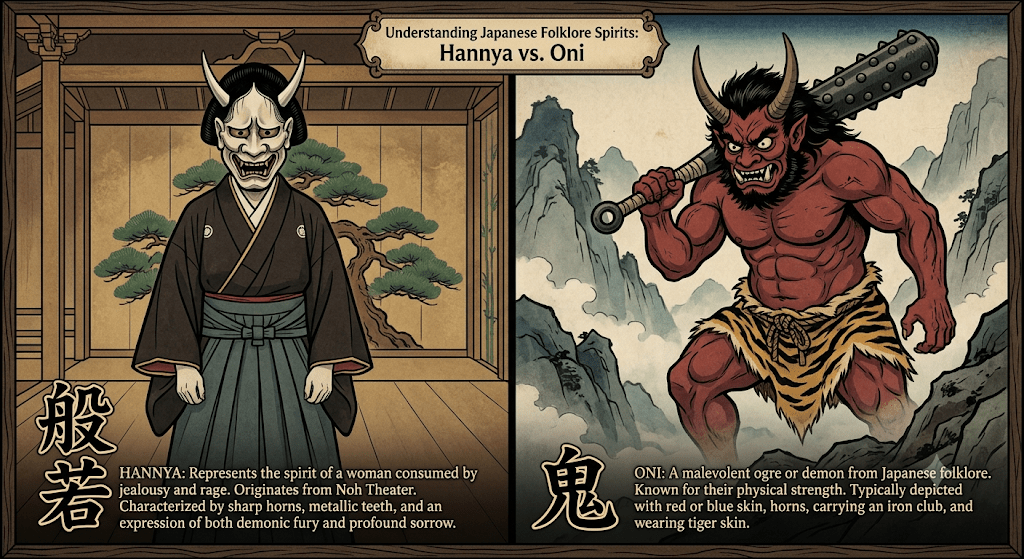
A Hannya is the ghost of a human woman consumed by jealousy and rage, while an Oni is a true demon from Japanese folklore. They might look similar at first glance, but their backstories and pairing rules are completely different.
The Hannya Mask – Human Tragedy
This one always hits differently when I explain it to clients. The Hannya is not actually a demon from hell. It comes from traditional Noh theater, and it represents a woman who has been betrayed by her lover. She’s been consumed by such intense jealousy, grief, and rage that her soul has literally mutated into a demon. It’s one of the most emotionally powerful motifs in all of Japanese tattooing.
The Rule: Because the Hannya represents heartbreak and raw emotional intensity, it’s almost always paired with Cherry Blossoms or Maple Leaves. Both of those motifs represent the fleeting, tragic nature of life and the way emotions change and evolve over time. The pairing tells a story of beauty destroyed by pain.
The Oni – Pure Chaos
The Oni is the real deal. It’s a true ogre from Japanese folklore. They’re giant, muscular, terrifyingly violent creatures with horns, and they carry massive iron clubs (kanabo). They’re basically the enforcers of hell, punishing the wicked and tormenting sinners.
The Rule: Oni are chaotic and brutal by nature. They’re often depicted fighting legendary human heroes (like Kintaro or Momotaro) or surrounded by fire, skulls, and storm clouds. There’s no subtlety with the Oni. It’s raw power and fury.
Why Is the Background More Important Than the Subject?
In Irezumi, the background (Mikiri) is arguably more important than the main subject because it creates the physical world the subject lives in. Without a proper background, your dragon or koi is just floating on your skin with no context, and that’s not how nature works.
Think about it this way. In Western tattooing, a sleeve is often just a collection of images floating on the skin, maybe tied together with some smoke or geometric dots. It can look great, but there’s no world behind it.
Irezumi is totally different. The background is the heavy black framing that encapsulates the entire tattoo. It creates a window into a different world. When done right, it feels like someone opened a portal on your arm and you can see an entire landscape inside.
Here are the strict rules for backgrounds:
Gaku (The Frame): The edges of the tattoo have to cut off cleanly in specific traditional shapes. The most famous is the Matsuba-mikiri (straight cut). Historically, this clean cutoff allowed the tattoo to stay hidden under a traditional Japanese kimono.
Water (Mizu): If the background features water, the waves (Nami) have to crash dynamically and flow in the same direction. Water must always flow downward, obeying gravity, unless a powerful creature like a Koi or Dragon is actively splashing it upward.
Wind (Kaze) and Clouds (Kumo): Wind bars and swirling clouds frame creatures of the sky like Dragons and deities. The wind has to swirl seamlessly around the anatomy of your body, creating a real sense of rapid movement.
And you can’t have ocean waves violently crashing into sky clouds without a natural transition (like a rocky shoreline) to separate the elements. Everything has to obey the physics of the real world.
Why Does RJ Tattoo Studio Enforce Traditional Irezumi Rules?
We enforce these rules because when you travel to Tokyo and reveal a Japanese back piece, any traditional Horishi will read it like a book, and we want yours to command instant, unspoken respect. We flat out refuse to give our clients imitations.
At RJ Tattoo Studio in Pune, we’re deeply, deeply passionate about the history and integrity of the tattoo craft. Whether you’re coming from Baner, Viman Nagar, or flying in from another city entirely, when someone sits down for a Japanese sleeve, we treat it as a massive responsibility.
It takes hours of consultation, research, and sketching to make sure that the piece we create for you obeys the ancient laws of Irezumi. And I want to be clear about something: we don’t enforce these rules because we want to be difficult or limit your creativity. That’s never the point. We enforce them because we want your tattoo to be respected anywhere in the world.
Here’s the simple truth: if your tattoo breaks the rules, anyone who knows Irezumi will immediately recognize it as a cheap, uneducated imitation. But if your tattoo obeys the rules? It commands instant, unspoken respect from every single person who understands the tradition. And that’s what I want for every client who sits in my chair.
When you invest in a large-scale Japanese tattoo at our studio, you’re not just getting ink on your skin. You’re getting a piece of art that carries the weight, the logic, and the fierce discipline of centuries of samurai history.
Ready to start your Irezumi journey? At RJ Tattoo Studio, one of the best Japanese tattoo studios in Pune, we take Irezumi seriously.
Book your free consultation on WhatsApp Phone: 096992 20129
Frequently Asked Questions About Japanese Tattoos
Can I get a traditional Japanese tattoo if I am not Japanese?
Yes course you can. The art of Irezumi is respected worldwide. As long as you approach the artwork with genuine respect, take the time to understand the meanings behind the motifs you’re wearing, and let your artist follow the traditional rules of composition, it’s a beautiful way to honor the culture and the craft.
How long does a full Japanese sleeve tattoo take?
A full Irezumi sleeve from shoulder to wrist typically takes anywhere from 30 to 50 hours of tattooing, broken into multiple day-sessions spaced a few weeks apart. The exact timeline depends on how complex the design is, your physical size, and honestly, how well you handle sitting through the pain.
Why is the background (Mikiri) so dark?
Great question. Traditional Japanese backgrounds use heavy, saturated black ink for two important reasons. Visually, that dense black pushes the colorful main subjects (a red Koi, a gold Dragon) to the foreground, creating massive contrast and depth. Historically, the heavy black was also a display of endurance, proving the wearer could withstand hours and hours of intense pain without flinching.
How much does a Japanese sleeve tattoo cost in Pune?
A high-quality Japanese sleeve in Pune typically ranges from ₹80,000 to ₹2,00,000 or more, depending on the complexity, the number of sessions, and the artist’s experience. At RJ Tattoo Studio, that pricing includes the custom design work, all consultations, and our premium imported inks.
Is it disrespectful to get a Japanese tattoo if I’m not Japanese?
Not at all, as long as you approach it with genuine respect and understanding. The key is working with an artist who actually knows the rules and can explain the meaning behind every element on your body. What is disrespectful is wearing a tattoo that violates the fundamental laws of the art form simply because it “looks cool” on Pinterest.
What is the difference between Irezumi and Horimono?
Irezumi literally translates to “inserting ink” and it’s the general term for traditional Japanese tattooing. Horimono refers specifically to large-scale, decorative body suits that follow strict compositional rules. The easy way to remember it: all Horimono is Irezumi, but not all Irezumi is Horimono.
Can I combine Japanese motifs with Western motifs?
You can, and this is often called “Neo-Japanese” or “Asian-fusion.” Some really talented artists do incredible work in this hybrid space. However, strict traditionalists won’t mix the styles. At RJ Tattoo Studio, if you want a true Wabori piece, we’ll strongly advise keeping the entire composition strictly traditional to preserve the visual harmony and cultural integrity.
Can I get a small Japanese tattoo, or does it have to be a full sleeve?
You can absolutely get a smaller piece. A single Koi, a Hannya mask, a chrysanthemum. There’s nothing wrong with starting small. However, the best Irezumi is always designed with expansion in mind. A skilled artist will compose even a small piece so it can naturally flow into a larger sleeve or body suit if you ever decide to continue down the road.
About the Author
Written by Raj Waghela – Founder and lead artist at RJ Tattoo & Piercing Studio, Pune and Mumbai, Maharashtra. Over 18 years of professional experience in custom tattooing, body piercing, and traditional Japanese tattoo composition. Internationally trained in cross-contamination prevention and specializing in large-scale, historically accurate Irezumi body art. If you’re looking for the best Japanese tattoo artist in Pune,
Book a free consultation today.
Phone: 096992 20129