The Physics of a Cover-Up: Why You Can’t Just Tattoo Light Colors Over Dark Lines
Tattoo ink does not act like wall paint. It acts like stained glass.
You cannot “erase” a heavy black tattoo by putting white, yellow, or light pink ink over it. The dark ink will always show through.
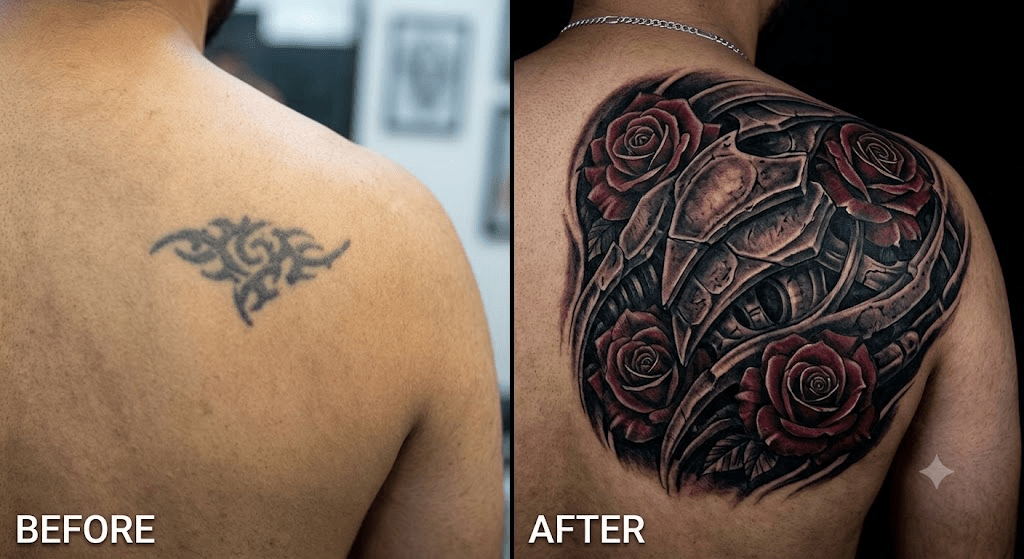
A successful cover-up must follow three strict rules: It must be larger, darker, and highly textured.
If your old tattoo is too dark and heavy, the only biological way to cover it with a lighter design is to fade it first with laser tattoo removal.
It happens at RJ Tattoo Studio Pune every single week.
A client walks in looking deeply embarrassed, pulls up their sleeve, and shows us a heavy, thick, blown-out black tribal tattoo they got on a whim ten years ago. Then, they pull out their phone and show us what they want to cover it with: a delicate, pastel watercolor flower.
They expect me to simply load up my machine with skin-toned or white ink, “erase” the black lines, and draw the flower on top.
I hate to break their hearts, but I have to explain a harsh biological reality: That is biologically and physically impossible.
Tattooing is not painting a wall. If you paint a red wall with two coats of white primer, the red vanishes, and you can paint a beautiful yellow sunflower over it. But your skin is not drywall. To understand why cover-ups are the most technically difficult challenge in the tattoo industry, you have to understand the physics of how ink lives inside your skin.
1. The “Wall Paint” Fallacy vs. The “Stained Glass” Reality
When you look at a tattoo, you are not actually looking at ink painted on top of the skin. You are looking at ink trapped deep underneath a translucent layer of skin (the epidermis).
Because the skin is translucent, tattoo ink acts exactly like stained glass.
Imagine holding a piece of black stained glass up to the light. Now, imagine taking a piece of light yellow stained glass and placing it directly over the black one. Does the black disappear? No. The light still has to travel through both pieces of glass, and the darkest color will always, unequivocally, dominate the lighter color.
If I tattoo solid white or pastel pink directly over a heavy black line, it might look like it covered it up on the exact day I do it, because the fresh white ink is sitting at the very top of the open wound. But within four weeks, as the top layer of skin heals and becomes translucent again, the dark black ink underneath will bleed straight through. The white will turn into a muddy, swampy grey.
2. The Biology: Why Macrophages Refuse to Let Go
To understand why the old ink stays put, we have to look at what a tattoo actually is on a microscopic level.
When a needle pushes ink into the dermis (the middle layer of your skin), your body’s immune system recognizes the ink as a foreign invader. It immediately sends white blood cells called macrophages to eat the ink and carry it away.
But tattoo pigment particles are too large for the macrophages to digest. So, the macrophages simply swallow the ink and die, freezing in place. When you get a new tattoo over an old one, you are just injecting new ink into the exact same dermal space where millions of ink-filled macrophages are already permanently trapped. The new ink mixes with the old ink.
Black + Yellow = Muddy Green. Black + White = Swampy Grey.
You cannot delete the old ink by adding more ink. You can only mix them.
3. The 3 Golden Rules of a Successful Cover-Up
Because of this stained-glass biology, professional cover-up artists at RJ Tattoo Studio have to use optical illusions to hide your old mistake. To trick the human eye, a cover-up must follow three strict rules:
Rule #1: It Must Be Larger (Usually 2x to 3x)
We cannot just trace over your old 2-inch tattoo with a new 2-inch tattoo. To trick the eye, the new design must command all the attention. We use the space around the old tattoo to create bright, beautiful details, drawing the eye away from the center where the old tattoo is hidden.
Rule #2: It Must Be Darker
We have to fight fire with fire. To hide heavy black lines, we must use heavy black, deep blues, dark purples, or rich dark greens. A master cover-up artist will place the darkest shadows of the new design directly over the darkest lines of the old design.
Rule #3: It Needs Texture and Detail
A smooth, flat wash of color will not hide old lines. We need highly textured designs to break up the shape of the old tattoo underneath. This is why Bio-mech, highly detailed Neo-Traditional, deep space galaxies, or heavily scaled dragons make incredible cover-ups. The chaotic texture of dragon scales completely scrambles the old lines hiding beneath them.
4. The Last Resort: When Laser is Mandatory
Sometimes, a client brings us a heavy, solid black square or an incredibly dark, dense tribal sleeve, and they refuse to get a massive, dark cover-up. They still want that delicate floral piece.
In this scenario, there is only one biological solution: Laser Tattoo Removal.
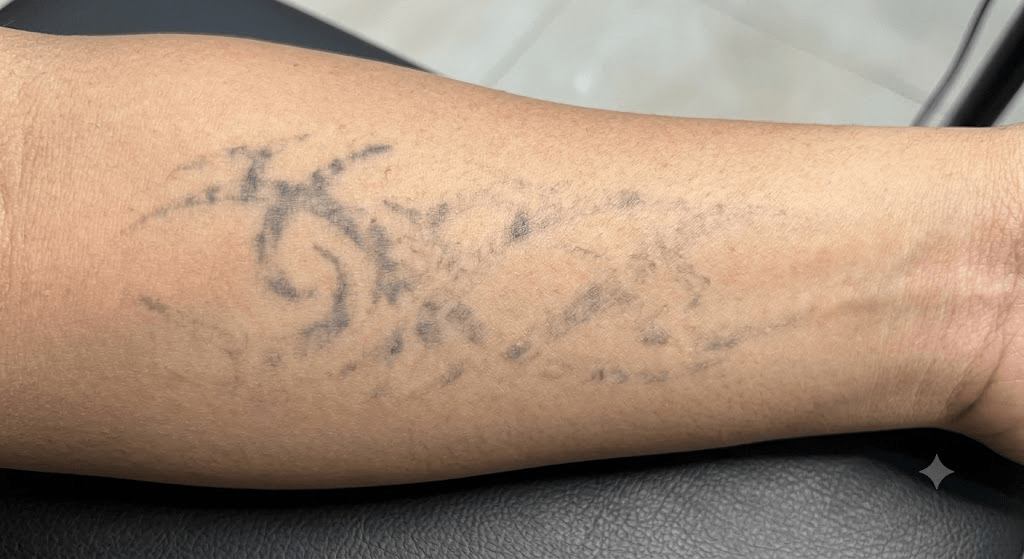
We don’t need to laser the tattoo completely off (which can take years). We just need to laser it 3 or 4 times to shatter the ink particles. Once the laser breaks the ink into microscopic fragments, your immune system finally flushes them away, turning that solid black line into a faint, pale grey ghost.
Then, we can tattoo your delicate floral piece over the faded ghost.
A cover-up is not a magic eraser; it is an incredibly complex game of biological chess. It requires a deep understanding of color theory, skin anatomy, and optical illusion.
If a budget tattoo artist tells you they can easily cover your dark black ex’s name with a bright yellow sunflower using “skin-colored ink,” run away. You will end up with a horrific, muddy mess that is twice as hard to fix.
Have a tattoo you desperately want to hide? Stop guessing what will work. Book a consultation at RJ Tattoo Studio in Pune. We will assess the density of your old ink and design a custom, optical-illusion masterpiece that actually works with the physics of your skin, not against it.
Frequently Asked Questions
Q: Can you use skin-colored ink to “erase” an old tattoo?
A: Absolutely not. This is a massive misconception. Skin-colored ink is essentially light brown, pink, and white pigment. Putting it over black ink just results in a muddy, bruised-looking grey blob once it heals.
Q: Why do some cover-ups look good when fresh, but terrible a month later?
A: When a tattoo is fresh, the new ink is resting at the very top of the epidermis. It looks incredibly bright and opaque. But during the 4-week healing process, that top layer of skin dies and flakes off. The new ink settles into the dermis alongside the old ink. If the artist didn’t use the correct cover-up physics, the old dark ink will bleed through the newly healed skin.
Q: How long should I wait before covering up a bad tattoo?
A: You must let the original tattoo heal completely before we can traumatize the skin again. This takes an absolute minimum of 6 to 8 weeks, though waiting a few months is ideal to ensure the skin’s collagen structure has fully reset.